The mining sector in the Kingdom of Saudi Arabia is undergoing a radical transformation as one of the three core pillars relied upon by Saudi Vision 2030 to diversify the national income, alongside industry and renewable energy.
However, the success of any ambitious mining strategy is measured not only by the volume of discovered reserves of gold, phosphate, bauxite, and copper but also by the ability to transport these riches from the depths of remote deserts to global port docks at the lowest cost and highest efficiency.
This is where Saudi mining infrastructure plays a pivotal role, with logistics networks and railways acting as the backbone connecting mining sites to international markets.
Saudi Mining Infrastructure and Railways: The Lifeline of the Saudi Mining Sector
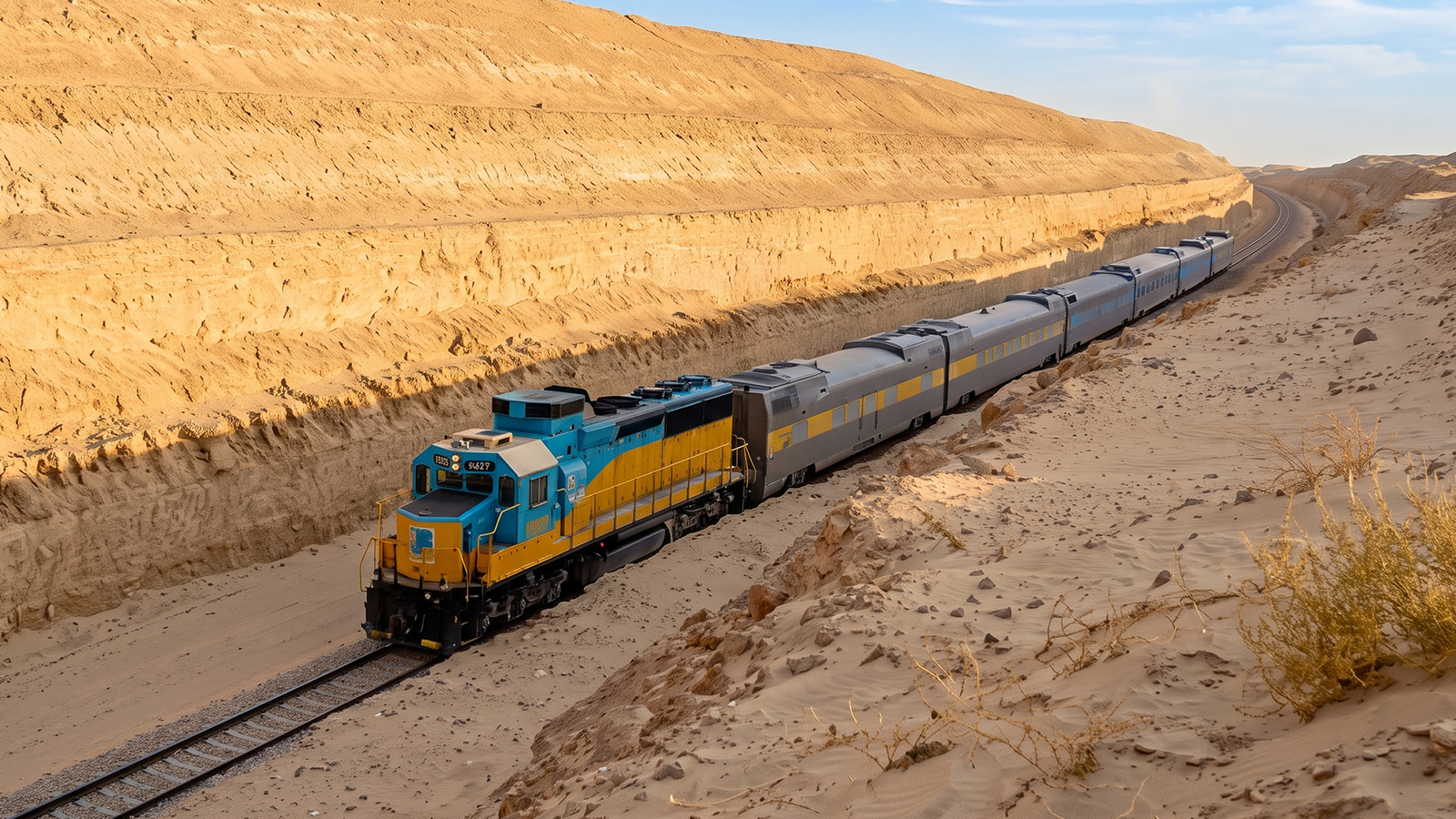
The North Train network (North Railway Line) is considered one of the largest infrastructure projects in the region, extending over 2,750 kilometers to connect rich mining regions in the north, such as Al-Jalamid and Az-Zubayrah—both rich in phosphate ore—with the mineral processing plant in the industrial city of Ras Al-Khair on the Arabian Gulf coast.
This railway line is not limited to passenger transport; a significant portion of its capacity is dedicated to hauling heavy freight, primarily phosphate and bauxite ores, at rates reaching millions of tons annually.
Before the establishment of this network, the cost of transporting minerals via trucks on public roads consumed a large portion of profit margins, alongside the environmental damage and traffic congestion caused by heavy truck convoys.
Today, the train is capable of transporting massive quantities of ore in a single trip, significantly reducing carbon emissions and boosting operational efficiency, which aligns with the Kingdom’s environmental commitments under the Saudi Green Initiative.
Saudi Mining Infrastructure Connecting Mining Sites to Ports: From Desert to Red Sea and Arabian Gulf
The Saudi mining ecosystem cannot be complete without a robust port infrastructure capable of receiving these massive volumes of minerals and exporting them to global markets.
The Kingdom enjoys a unique strategic geographic location overlooking two major seas: the Red Sea and the Arabian Gulf, granting it great flexibility in choosing the shortest and safest export routes.
Ras Al-Khair Industrial Port: The primary destination for phosphate and fertilizer exports, receiving shipments directly from the North Train via internal rail lines linking it to factories and loading terminals.
King Abdulaziz Port in Dammam: Forms a vital connection point for mineral exports heading toward Asian and Far Eastern markets via the Arabian Gulf.
Jazan Port and Yanbu Industrial Port: Provide a strategic outlet on the Red Sea that shortens travel time to European and African markets, giving exporters a competitive advantage in delivery times.
Smart Logistics and Operating Cost Reduction
With the expansion of major mining projects such as the Mansourah-Massarah phosphate project and gold mining projects in the Al-Madinah and Al-Jawf regions, the need has become urgent to adopt smart logistics solutions driven by modern technologies, including:
Real-time Shipment Tracking Systems: Allowing mining companies to monitor ore movement from extraction to port arrival, minimizing delays and losses.
Predictive Maintenance Analysis: Helping maintain the efficiency of locomotives and freight cars while reducing unscheduled downtime that inflicts heavy financial losses on companies.
Digital Integration Between Entities: Accelerating cargo release procedures and reducing port turnaround times by linking Saudi Railway Company (SAR) systems with customs and port networks.
These technological solutions strengthen Saudi mining infrastructure and directly contribute to reducing the cost per transported ton, a decisive factor in the ability of Saudi products to compete globally against producers from countries like Australia, Chile, and Morocco.
From Mine to Market: How Saudi Minerals Move Through the Supply Chain
Saudi mining infrastructure supports a connected journey that moves minerals from remote mining areas to industrial hubs and export gateways through an integrated supply chain:
- Extraction starts at mining sites, including phosphate operations in Wa’ad Al Shamal and bauxite mining at Al Ba’itha, where raw materials enter the first stage of the value chain. Ma’aden, Ma’aden Aluminum
- Minerals are transported by rail to major industrial destinations, especially Ras Al Khair, with rail links supporting the movement of phosphate and bauxite from mining areas to processing facilities. PIF
- Processing and value-added production take place locally, helping the Kingdom move beyond raw material exports. In phosphate, Wa’ad Al Shamal focuses on mining and processing, while Ras Al Khair manages finishing, storage, and export to global markets. Ma’aden
- Industrial complexes near ports complete the production cycle, particularly in Ras Al Khair, which hosts major phosphate and aluminum facilities connected to Saudi Arabia’s wider mining strategy. PIF
- Final products are shipped to international markets, with Ma’aden’s phosphate supply chain serving customers in more than 30 countries and supporting Saudi Arabia’s position in global mineral and fertilizer markets. Ma’aden
Maximizing Value-Added Before Export
One of the prominent strategies currently adopted by the Kingdom is to go beyond simply exporting raw materials, focusing instead on local processing and manufacturing prior to shipment to elevate the economic value of the product.
This is where logistics infrastructure plays its role once again, as this orientation requires integrated industrial zones near ports equipped with internal rail lines connecting:
- Extraction sites.
- Processing and refining complexes, such as the Ras Al-Khair complex for phosphoric acid and fertilizer production.
- Final shipping docks.
This integrated model ensures minerals are not exported as cheap raw materials but as final or semi-final products with higher added value, yielding greater economic returns and creating quality jobs in industry and logistics.
Future Expansions of the Railway Network
The Saudi Railway Company (SAR) is conducting studies to expand the current network to encompass newly discovered mining sites identified through the comprehensive geological survey launched by the Ministry of Industry and Mineral Resources.
These expansions are expected to include:
- New lines directly connecting copper and zinc mining areas in the Western Region to Red Sea ports.
- Enhancing connectivity between the Northern network and the East-West network, the Landbridge project, to provide greater flexibility in selecting export routes based on the final destination.
- Investments in modern handling facilities that minimize ore loading and unloading times.
Saudi Mining Infrastructure as a Growth Driver
Saudi mining infrastructure, especially the integration between railways and maritime ports, represents a successful model for transforming natural resources into genuine economic value.
Thanks to its distinguished geographic location between two seas and massive investments in logistics infrastructure, the Kingdom is positioning itself competitively within global mineral supply chains.
As expansions in these networks continue and smart logistics solutions are adopted, the Kingdom moves steadily toward cementing its status as a leading regional and global hub for the mining industry, serving the objectives of Vision 2030 in diversifying the economy and reducing oil dependence.
Read Also: The Hidden Wealth: Strategies for Developing Phosphate Extraction and Processing in KSA