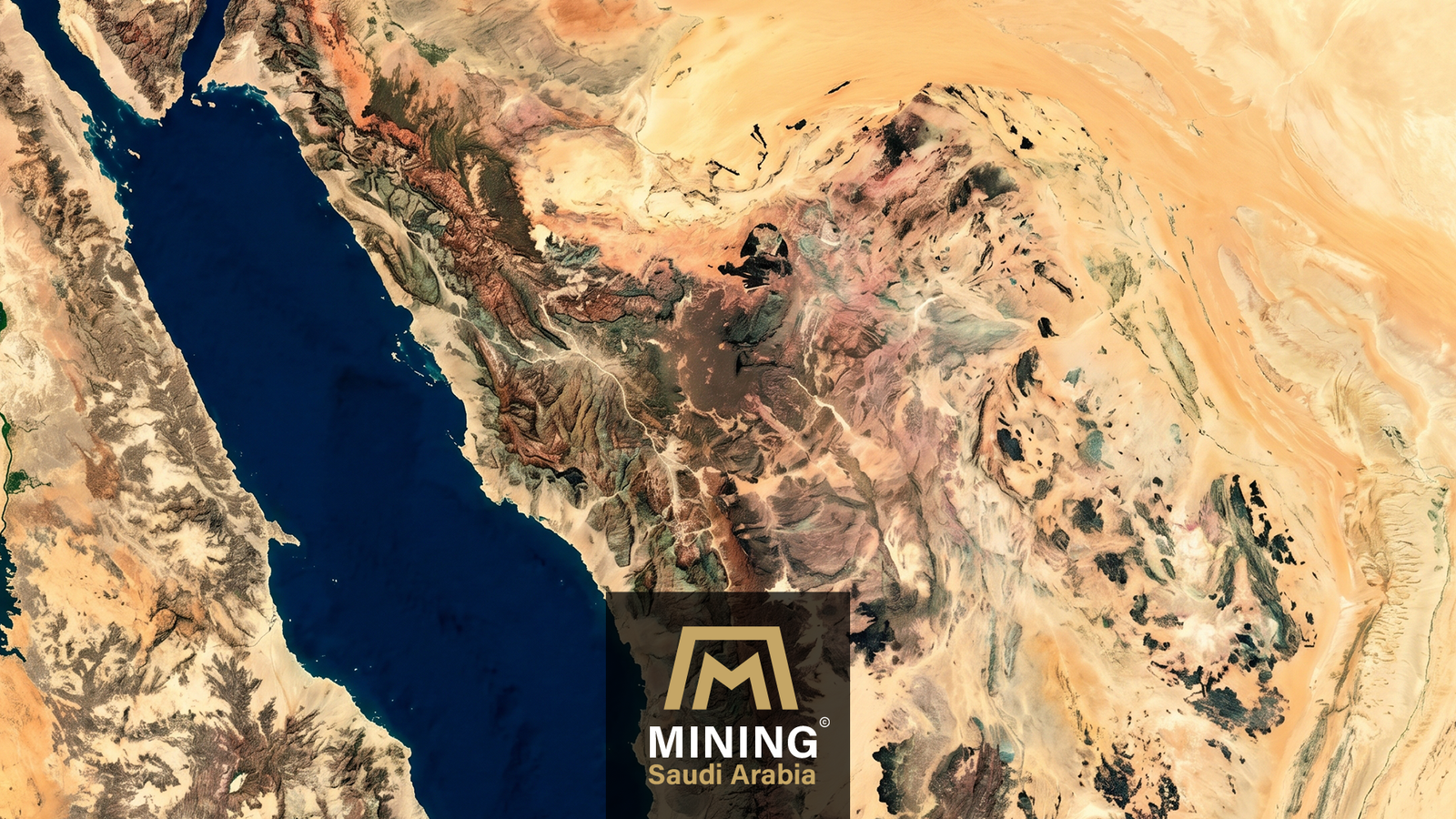
Volcanogenic Massive Sulfide (VMS) deposits are cornerstone assets in the global base metals industry. The Arabian Shield, which extends across the Kingdom of Saudi Arabia, represents one of the most geologically promising regions for hosting these deposits. The shield’s unique geological nature, formed through the accretion of ancient island arcs, provides an ideal tectonic environment for copper and zinc accumulation. Exploring for these deposits in the remote and arid regions of the Kingdom requires a specialized technical approach that integrates structural geology, advanced geophysics, and mathematical modeling. This report deconstructs specialized exploration methodologies within the geological context of the Kingdom.
Host Rock Lithogeochemistry
In the Arabian Shield, lithogeochemistry is the first line of defense in distinguishing barren systems from mineralized ones. Modern strategy relies on analyzing immobile trace elements (e.g., Zr, Ti, Y, Nb, Th) to classify complex volcanic components within the Kingdom’s formations (such as the Arj or Samrah groups).
- Tectonic Environment Discrimination: Through geochemical discrimination diagrams, we can determine if the shield’s volcanic rocks originated in mature island arcs or back-arc basins, the most fertile environments for VMS formation.
- Hydrothermal Alteration Indices: Elevated Alteration Index (AI) and Chlorite-Carbonate-Pyrite Index (CCPI) values reflect ionic exchange between ore-forming fluids and host rocks in the Arabian Shield. We use these “alteration halos” as vectors to pinpoint the centers of hydrothermal systems in remote areas like Wadi Murra.
Geophysical and Magnetic Signatures of Hydrothermal Systems
In remote regions of the kingdom, where vegetation is sparse and sedimentary cover predominates, geophysics remains the primary tool for sub-surface penetration.
- Electromagnetic (EM) Response: VMS deposits in the Arabian Shield exhibit sharp reactions to airborne electromagnetic surveys. Surveys conducted by the Saudi Geological Survey enable high-resolution conductivity mapping, which reveals “ore conductors” and helps bypass the challenge of sandy cover obscuring parts of the shield.
- Magnetic Destruction: Hydrothermal activity associated with Saudi VMS deposits often destroys primary magnetic minerals in the host volcanic rocks, resulting in a “magnetic low.” This anomaly serves as a diagnostic milestone in our local explorations, identifying fluid pathways responsible for ore deposition.
Structural Tectonic Analysis and Controls
The geometry of VMS deposits in the Kingdom is governed by structural features formed during Precambrian plate tectonic movements.
. Transform Faults: Faults cutting across volcanic arcs in the Arabian Shield play a crucial role in creating sub-basins. Modeling these faults using seismic data and high-resolution magnetic surveys helps identify “structural traps” where minerals are concentrated at sites like Jabal Sayid.
. Stratigraphic Thickness Control: Analyzing the stratigraphic succession in the shield’s volcanic complexes helps identify the “ore horizon” that must be tracked over long distances, significantly narrowing the search area in unexplored regions.
3D Deposit Modeling
In major exploration projects within the Kingdom, 3D modeling has become the gold standard:
- Data Integration: Integrating national geophysical survey data with drill-core logs from the Kingdom’s known deposits.
- Geostatistical Interpolation: Utilizing algorithms to estimate and distribute copper and zinc grades within the ore body. These models allow for the calculation of “geological risk” and guide drilling operations with high precision to minimize waste, which is vital for maximizing mining investment efficiency in alignment with Vision 2030 objectives.
Mineral Zonation Patterns
VMS deposits in the Arabian Shield exhibit clear mineralogical gradients:
- Core: Characterized by copper enrichment (chalcopyrite) and the underlying “stockwork” hydrothermal feeder zone.
- Margins: Composed of zinc and lead sulfides (sphalerite and galena), which are often thinner but more laterally extensive.
- Local Application: By analyzing associated minerals (such as talc, chlorite, and sericite) via electron microscopy in national laboratories, we can determine proximity to the central “vent,” optimizing the deployment of drill rigs in the field.
Hyperspectral Mapping of the Earth’s Surface
In the Kingdom’s arid environment, spectral scanning emerges as a revolutionary technique supported by the dry desert climate:
Spectral Signatures: Sensors mounted on drones or high-resolution satellites can detect metamorphic minerals (e.g., kaolinite, illite, and montmorillonite) resulting from the interaction of hot fluids with Arabian Shield rocks.
Alteration Halo Mapping: This technique enables high-precision mapping of geochemical alteration zones over vast scales, providing a geological “compass” for explorers in promising prospecting regions before initiating costly ground surveys.
The Future of Exploration in the Arabian Shield
Exploring for VMS deposits in the remote regions of Saudi Arabia requires a shift from “random prospecting” to “systems-based targeting.” Integrating high-precision lithogeochemistry, national geophysical data, and 3D modeling creates opportunities to discover deep-seated deposits in the Arabian Shield that were previously considered inaccessible.
The true challenge in the Arabian Shield is not a scarcity of minerals but the ability to interpret the subtle geological signals left by these systems beneath the desert cover. By adopting these specialized technical methodologies, the Kingdom can bolster its strategic reserves of base metals and ensure the sustainability of the mining sector as a pillar of the Kingdom’s industrial future, underpinned by rigorous geological science and advanced exploration technology.