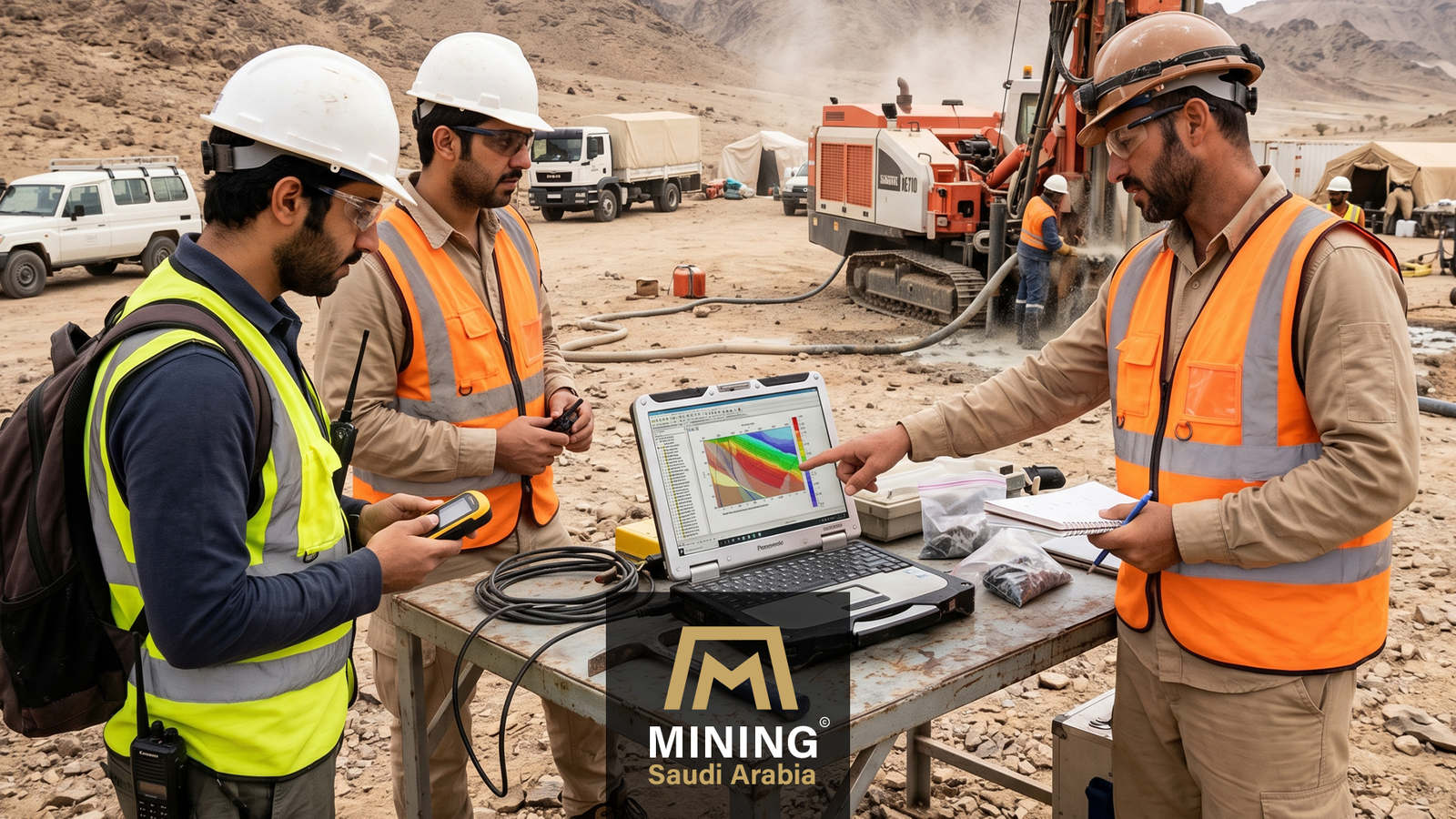
The mining sector in the Kingdom of Saudi Arabia is experiencing an unprecedented renaissance, representing the “Third Pillar” of national industry under Saudi Vision 2030. As the focus shifts from surface-level deposits to targeting deep-seated mineral resources hidden beneath thick sequences of cover rock, the need for advanced exploration technologies has become paramount in Mining Exploration in Saudi Arabia. This is where Deep Exploration-utilizing Magnetotellurics (MT) and high-resolution magnetic surveys-comes into play, serving as the cornerstone for uncovering untapped wealth within the Arabian Shield.
The Economics of Deep Exploration in Saudi Arabia: Balancing Risk and Reward
The economics of mining in emerging regions revolve around the triad of cost, risk, and reward. By nature, deep exploration requires high initial capital investment; however, it significantly mitigates “geological uncertainty,” which is the single greatest challenge facing investors and field operators, particularly within Mining Exploration in Saudi Arabia.
Economic Factors Impacting Deep Exploration:
|
Impact on Exploration Operations |
Factor |
|
Minimizes “blind” drilling, saving millions of dollars in drilling programs |
Geophysical Data Accuracy |
|
MT technology allows for reaching depths exceeding 500 meters up to several kilometers |
Reaching Extreme Depths |
| Rapid target identification accelerates the project’s economic feasibility stage |
Reduced Timelines |
| High-precision data provides global investors with confidence in resource sustainability |
Attracting Foreign Investment |
Magnetotellurics (MT) in Mining Exploration in Saudi Arabia: Probing the Earth’s Depths
Magnetotellurics (MT) is one of the most powerful passive geophysical tools, measuring natural variations in the Earth’s magnetic and electrical fields.
Why Use MT in the Arabian Shield?
The rocks of the Arabian Shield are characterized by geological complexity and diverse electrical conductivity. MT technology maps 3D resistivity at significant depths, assisting in:
- . Identifying Tectonic Zones: Detecting deep-seated faults that serve as conduits for mineral-bearing fluids.
- . Detecting Conductive Bodies: Identifying massive sulfides located beneath thick, non-conductive rock layers.
- . Mapping Thermal Systems: Understanding the hydrothermal systems associated with gold and copper deposits.
High-Resolution Magnetic Surveys: The Compass to Hidden Targets
While MT dives into the depths, High-Resolution Magnetic Surveys map the structural and compositional details of the crustal layers with extreme precision.
Technical Benefits of Magnetic Surveys:
- Structural Mapping: Detecting folds and dykes often associated with gold mineralization.
- Igneous Rock Delineation: Distinguishing between various rock types based on magnetic susceptibility.
- Identifying Alteration Zones: Spotting zones that serve as vital indicators for Copper and Zinc (VMS) deposits.
Innovation in Geo-Data Analysis and GIS
Mining Exploration in Saudi Arabia relies on the fact that data collection is only the beginning. These surveys are integrated with advanced Geographic Information Systems (GIS) to process and analyze massive geophysical datasets. This integration contributes to:
- Next-Generation Geological Mapping: Merging updated satellite imagery with magnetic and electromagnetic survey results.
- 3D Modeling: Transforming raw MT data into visual models that describe the subsurface clearly, facilitating informed decision-making.
- Improving Interpretation Accuracy: Overlapping multi-source spatial data to reduce risk and error in selecting exploration drilling sites.
Maximizing Returns: Integration Between Geophysics and Drilling
The importance of deep exploration extends beyond mapping; it is the primary guide for Diamond Drilling and Reverse Circulation (RC) programs. Linking “geophysical anomalies” with “core samples” is the true litmus test for the success of any mining project.
How Deep-Data Supports Drilling Efficiency:
- Steering Drill Holes: Using 3D models derived from MT, geologists can accurately determine the dip and azimuth to reach the center of the mineral body via the shortest distance.
- Cost Management: Deep drilling is expensive. Utilizing high-resolution magnetic data reduces “dry holes,” thereby increasing the exploration success rate.
- Refining Geological Models: Once drilling results are obtained, the data is fed back into modeling software (such as Surpac) to compare with geophysical data, creating a continuous loop of model refinement.
Challenges and Solutions in the Saudi Arid Environment
Mining Exploration in Saudi Arabia continues to advance despite the fact that deep exploration faces logistical challenges addressed through innovation:
- Rugged Terrain: Overcome by using Aeromagnetic Surveys conducted via helicopters or drones.
- Water Scarcity: These geophysical techniques rely on physical measurements that do not consume water, making them ideal for arid regions and more environmentally sustainable.
- Specialized Expertise: This type of exploration requires experts in data processing, a need supported by the Kingdom’s initiatives to localize mining expertise.
Economic and Developmental Impact
Investing in deep exploration technologies serves as a major driver for national development:
- Export Diversification: Discovering new minerals and Rare Earth Elements (REE) required for clean energy technologies.
- Job Creation: Providing high-quality employment opportunities for geological and technical cadres in remote regions.
- Supporting Downstream Industries: Securing local raw materials for aluminum, phosphate, and heavy industries.
The Future of Mining in the “Arabian Shield”
The transition toward deep exploration using Magnetotellurics and high-resolution magnetic surveys is the inevitable path to achieving the goals of Saudi Vision 2030. By reducing geological risk and improving target precision, the Kingdom positions itself at the forefront of global investment destinations, transforming the Arabian Shield into a cradle of mineral wealth for future generations.
Read Also: Digital Geology 3D Modeling: A Powerful Roadmap Reshaping the Mining Landscape