In the heart of the Arabian desert, where ancient geology meets modern mining technology, heap leaching plays a key role in turning low-grade ores into valuable mineral resources.
For the Saudi Arabian Mining Company (Maaden), particularly at its Bulghah gold mine, heap leaching offers a practical way to recover gold from ores that may be uneconomical to process with conventional methods.
But how does heap leaching work, and what makes it an important technology for Saudi Arabia’s mining industry? This article explores the science, engineering, and operational principles behind the process, from ore preparation and chemical reactions to gold recovery and environmental management.
What is heap leaching, and why is it Maaden’s lifeline?
Historically, the mining industry relied on traditional smelting or massive, high-cost processing plants to handle high-grade ores. But what about rock sheets containing only trace amounts of gold, copper, or precious metals? Are they left behind and wasted? Herein lies the role of Heap Leaching as a hydrometallurgical engineering technique aimed at economically extracting target metals from low-grade ores without full crushing or consuming energy-intensive smelting processes.
For the Saudi mining giant “Maaden,” especially in massive projects like the Bulghah gold mine and other mining sites, heap leaching represents an ingenious strategy to lower operating expenditures (OPEX) and raise recovery efficiency for billions of tons of rock. The core idea relies on forming massive piles of crushed rock over engineered, impermeable pads, slowly irrigating them with dissolving chemical solutions, and letting gravity do the work of pulling the dissolved metal down into precise collection channels.
The Story of Hidden Gold: How “Ordinary Rocks” Turn into Heaps of Wealth
If you imagined that extracting gold always required tons of complex machinery and giant factories to crush every rock on Earth, you might be surprised by the astounding truth!
In the projects of the Saudi mining giant “Maaden,” there is a type of rock that at first glance looks like ordinary mountain rock or scattered desert gravel, where atoms of gold or precious metals are dispersed in tiny, uneconomical proportions for traditional crushing. Here lies the true magic of Heap Leaching.
To picture this clearly, imagine making a strong cup of tea: you place the tea leaves in a strainer (or heap), then slowly pour hot water over them, allowing the water to absorb the flavor and color and carry it down into the cup below.
This is precisely what Maaden does in the heart of the desert:
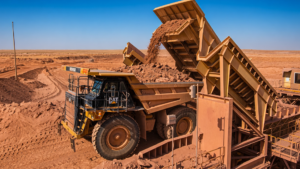
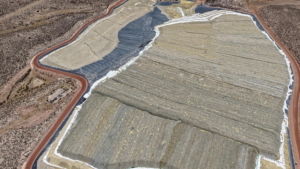
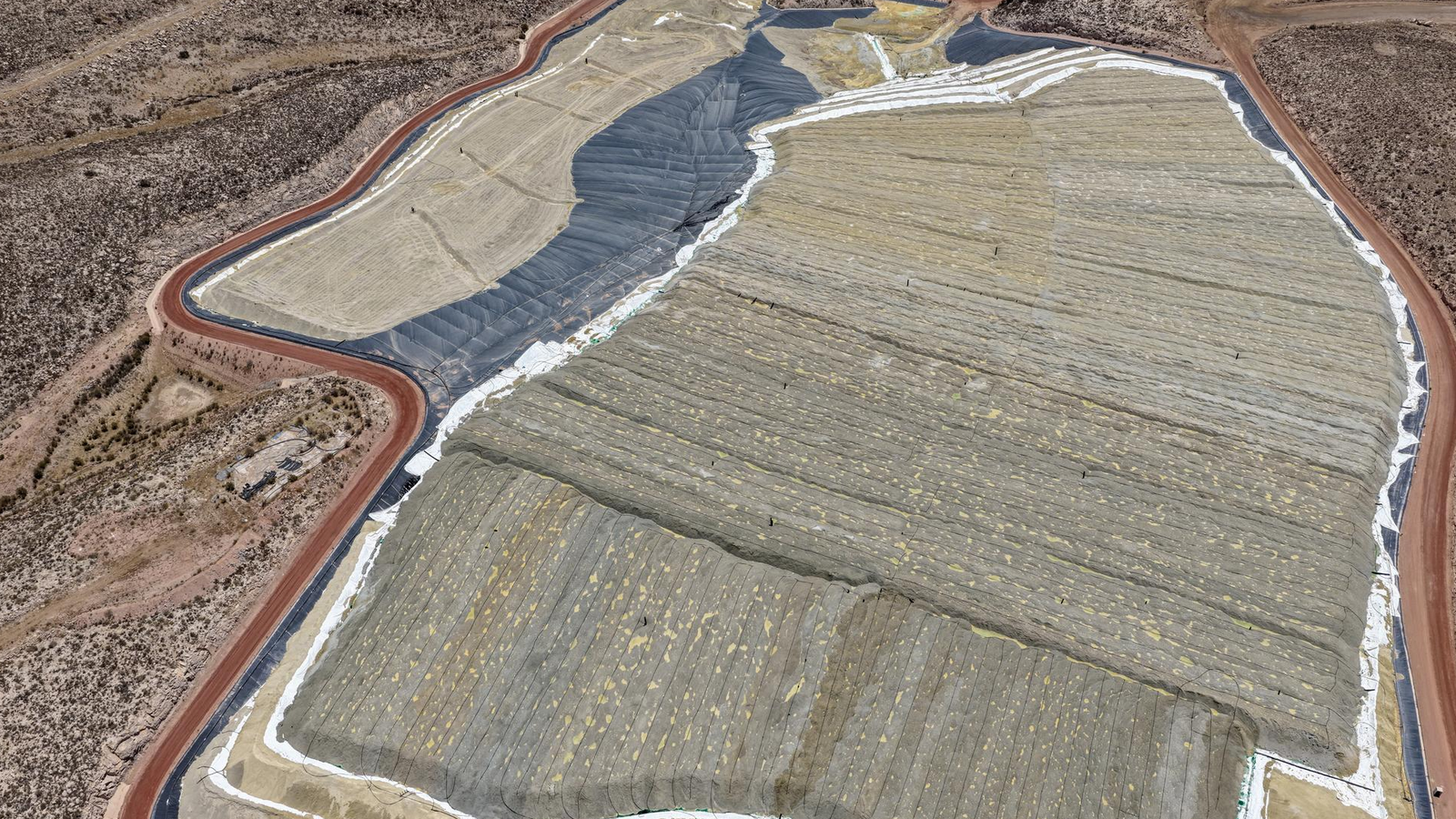
1- Massive Heap Construction: Millions of tons of rock are gathered and carefully placed over a completely safe, insulating base that protects the desert environment and groundwater.
2- Smart Irrigation: These heaps are irrigated very slowly via drip-irrigation-like pipe networks using a special solution designed to dissolve only the targeted metal.
3- The Harvest: Driven by gravity, this wealth-laden solution trickles down through the rocks to be collected and processed, extracting gold with complete safety and ease.
The Engineering Anatomy of the Process: How is the Ultimate Heap Built?
To achieve the superior operational efficiency relied upon by “Maaden,” a heap is never just an accidental pile of dirt; it is a major engineering facility consisting of several precise layers and stages:
. Leach Pad Liner System: Protecting the environment and subsurface is the top priority. The floor is lined with dual layers of High-Density Polyethylene (HDPE) membranes and compacted clay layers to prevent any seepage of the metal-bearing chemical solution toward groundwater.
. Advanced Conveyor Belt Systems: In Maaden’s projects, millions of tons of crushed rocks are transported via long, highly efficient conveyor belts (sometimes stretching over a kilometer in a single run) to distribute the ore smoothly and with precise engineering over the pads to prevent overlapping or excessive compaction.
. Drip Irrigation Networks: The leaching solution (typically cyanide for gold extraction) is distributed via surface piping and spray networks, ensuring a uniform, controlled flow through rock pores.
Advanced Scientific Depth: Leaching Thermodynamics and Kinetics
For specialists and researchers, let us dive into the core chemical and physical equations governing this process inside Maaden’s facilities:
Reaction Kinetics and the Shrinking Core Model
Gold extraction via heap leaching follows the Shrinking Core Model. When a sodium cyanide (NaCN) solution penetrates the capillary pores of a rock particle, a well-known redox reaction occurs, described by Elsner’s Equation:
4Au + 8NaCN + O_2 + 2H_2O = 4Na[Au(CN)_2] + 4NaOH
This complex reaction requires strict monitoring of three main kinetic factors:
Oxygen and Solvent Diffusion Rate: Through the micro-pores of the crushed rock.
Product Layer Resistance: Where secondary layers occasionally form, hindering the solution from reaching the core of the mineral particle.
Specific Surface Area: Controlled precisely through preliminary crushing operations.
Geochemical pH Control
To prevent cyanide ions from degrading into toxic hydrogen cyanide gas (HCN), which wastes operational economics, Maaden’s facilities maintain a highly stable alkaline environment, typically ranging between pH 10.5 and 11.5, using quicklime (CaO) pre-mixed with the ore (agglomeration). This step protects the environment and improves heap permeability by agglomerating fines with coarse rocks, preventing pore clogging and preferential flow.
Innovation and Sustainability: Maaden’s Footprint for the Future
Technology does not stop at the traditional boundaries of heap leaching; Maaden has invested in state-of-the-art dynamic modeling and computer simulation techniques to optimize leach pad performance. These innovations include:
. Sensor Monitoring Systems: Utilizing moisture, temperature, and electrical potential sensors inside the heaps to predict recovery rates in real time.
. Zero-Water Management: Recycling all extracted solutions through carbon-in-pulp/carbon-in-column (CIP/CIC) adsorption stages to ensure zero water is wasted in a desert environment demanding the highest standards of environmental efficiency.
Conclusion and Strategic Vision
Heap Leaching technology at Maaden is much more than a routine engineering process; it is an inspiring model of operational efficiency and sustainable innovation that blends profound scientific understanding with conscious accessibility, creating a comprehensive reference for anyone interested in the mining sector.
Read Also: The Vital Role of Infrastructure and Railways in Connecting Mining Sites to Global Markets